CFTC and prop firms in 2026: what has actually changed
Retail prop evaluations are still largely unregistered. Some US firms added CFTC introducing-broker affiliates for live accounts. What that split means.
From Copilink, which makes trade copiers for running several futures prop firm accounts from one leader. See how it works →
Most retail futures prop evaluations are still not a CFTC-registered product. What changed in 2026 is that some US firms stood up a separate, registered introducing-broker (IB) for live personal accounts, next to the unregistered eval/funded book. That is a split, not a new rule that turns every simulated seat into a regulated fund.
Registration and a firm's own trading agreement are separate checks. For copier use, the firm warning guide covers account ownership, hedging and prohibited patterns.
Nothing on this page is legal advice. Check NFA BASIC and the CFTC registration check for a named entity. Firm structure moves faster than blog posts.
The simulated book is still the product
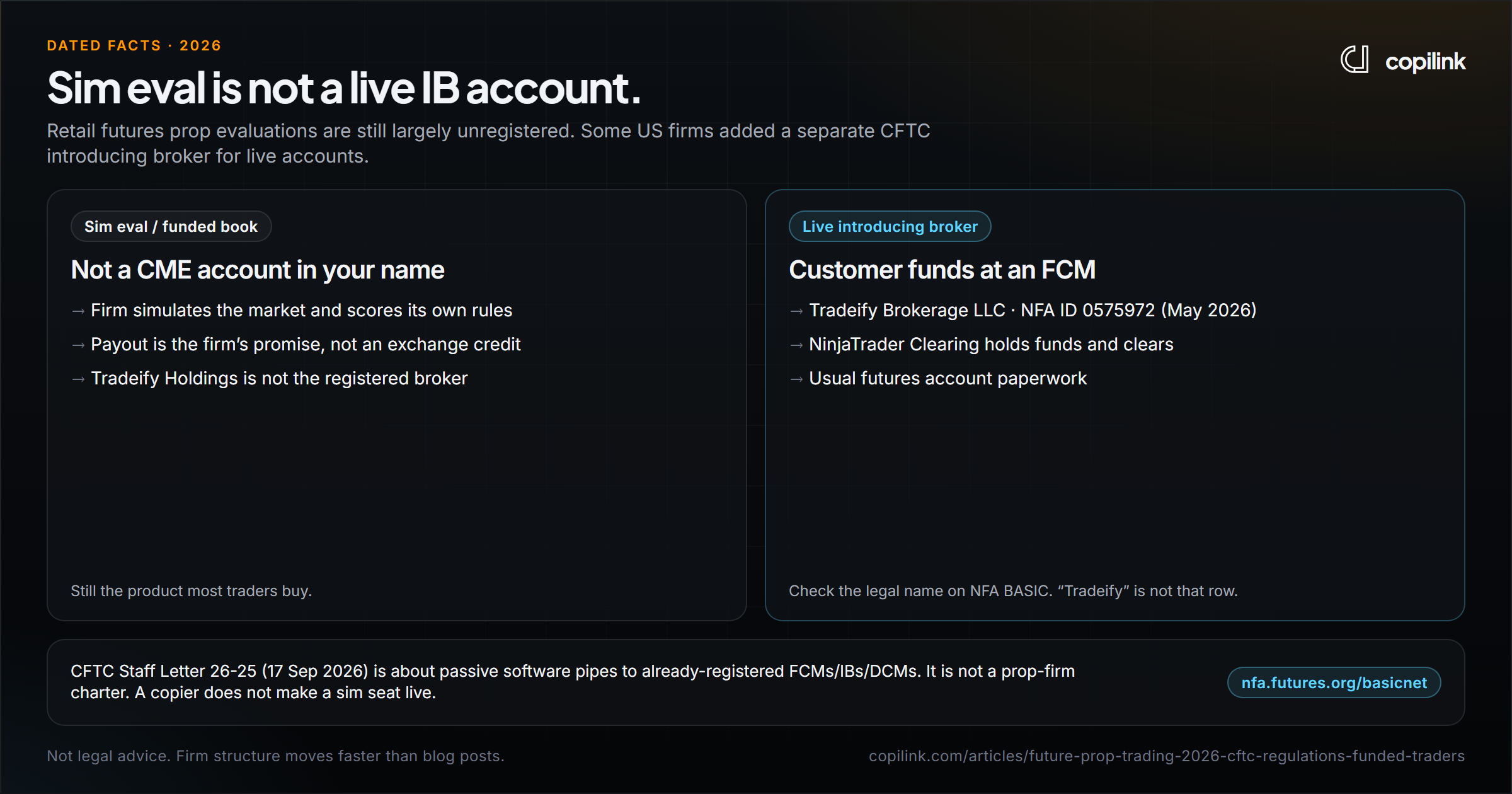
A typical futures prop eval does not give you a live CME account in your name. The firm simulates the market, scores you against its rules, and pays from its own funds when you pass its payout tests. That design is why these businesses have argued they are not commodity trading advisors or introducing brokers for the eval itself.
When a firm has tens of thousands of those seats and is paying out real dollars, the economic picture looks less like a video game. That is the tension. It is not, by itself, a new CFTC rulebook titled "prop firms."
What actually happened, with dates
My Forex Funds (2023–2025). The CFTC sued a large forex prop operator in 2023. Reporting in May 2025 described that case as dismissed. It was a warning shot about how the Commission might treat retail prop marketing. It did not produce a registration category for futures evals.
Tradeify / Slay Markets (May 2026). Tradeify launched Slay Markets under Tradeify Brokerage LLC, a CFTC-registered introducing broker and NFA member (NFA ID 0575972 in public directories). NinjaTrader Clearing is the FCM: it holds funds and clears. Tradeify Holdings, the prop entity, is not the registered broker. Early access was aimed at Tradeify funded traders. Co-founders have said the IB is a path from sim payouts into a live account, not a claim that the eval itself is now regulated. TradeInformer, 19 May 2026; FinanceFeeds, Aug 2026.
Topstep. Public reporting in 2026 described Topstep as building regulated affiliates alongside the prop brand. Treat that as "check BASIC for the legal name," not as proof the Combine is a registered FCM account.
CFTC Staff Letter 26-25 (17 September 2026). Staff said it would not recommend IB/AP enforcement against qualifying passive software providers that connect users to already-registered FCMs, IBs, or DCMs, if they do not take custody, do not use discretion over orders, and meet the letter's other conditions. That letter is about software pipes, including crypto front ends. It is not a prop-firm charter. FinanceFeeds, 18 September 2026.
What this split means if you are funded
The eval/funded seat and a live IB account are different contracts. Payout from a sim book is still the firm's promise, not an exchange credit. A live IB account is customer funds at an FCM, with the usual futures account paperwork.
If a firm offers both, you can take sim payouts and fund a live seat. You can also keep stacking evals. Those are different risk piles. A copier that can reach Tradovate or Rithmic on accounts you own is useful for the stack you are allowed to copy. It does not make a sim seat live, and it does not move money between legal entities.
How to run the book without betting on one firm's structure
- Do not put every funded dollar at one firm. Closures and payout delays have already happened in this industry without a new statute.
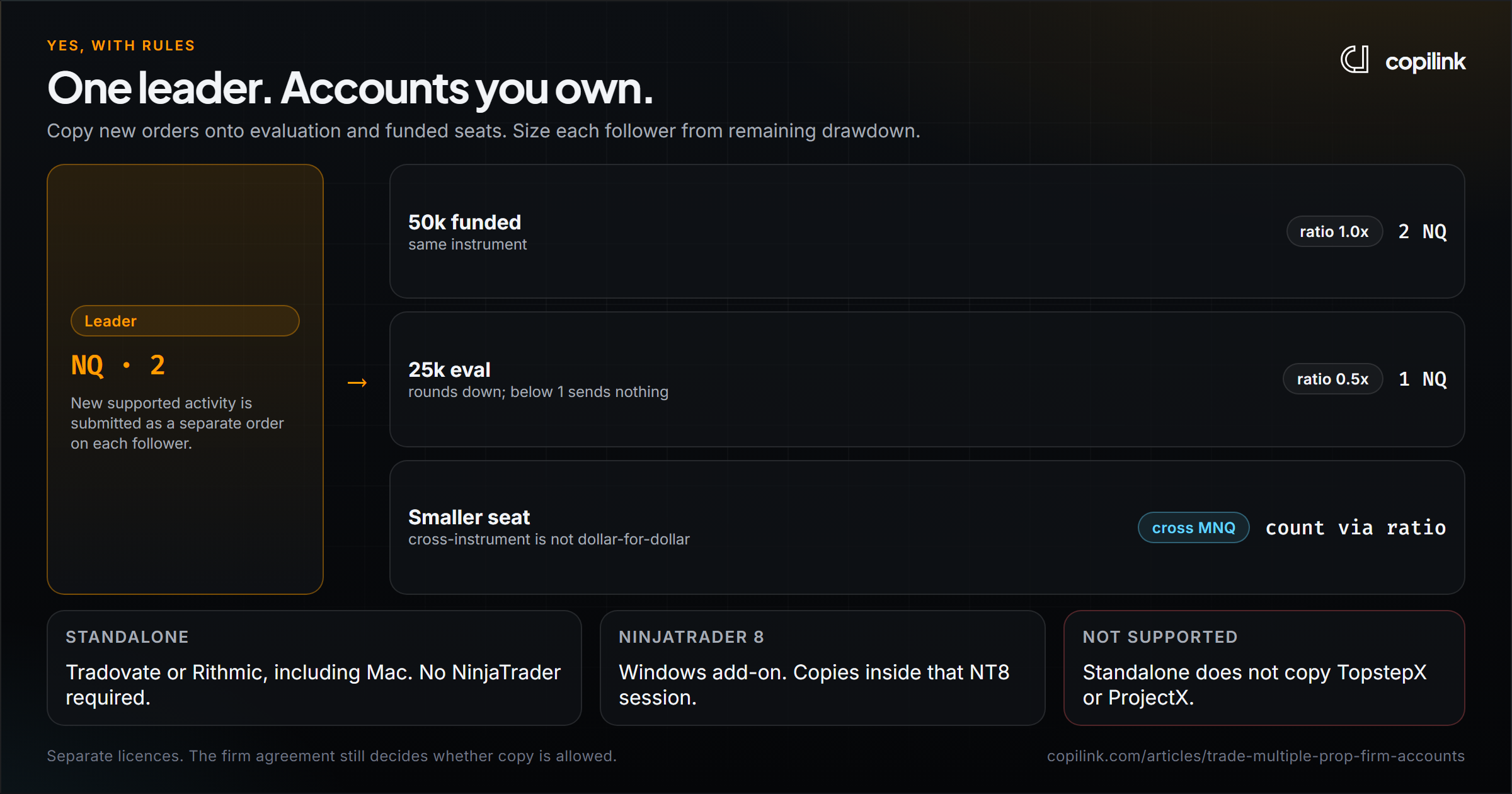
- Keep the copier off any one firm's native tool. If that firm changes platforms or shuts a product, you still have a way to copy the seats that remain. Copilink Standalone talks to Tradovate and Rithmic directly. Copilink for NinjaTrader 8 is a separate NT8 add-on.
- Confirm entity names on NFA BASIC. "Tradeify" and "Tradeify Brokerage LLC" are not the same row.
- For which firms currently allow owned-account copying, use prop firms that allow copy trading. For the copier shortlist, best trade copier for prop firms.
The trading problem does not change: one decision, several owned accounts, rules that fail you if a follower drifts. The legal wrapper around some of those accounts is starting to fork. Trade the rules on the dashboard in front of you, and read the registration page for the live entity if you open one.
Continue this topic
Compare prop firm rules and account routes →Trade without NinjaTrader
Copilink Standalone is a futures trade copier for Tradovate and Rithmic on Windows and macOS. The trial lasts 14 days and does not require a card.
Already use NinjaTrader 8?
The Copilink NinjaTrader 8 trade copier runs inside NinjaTrader 8 on Windows and includes a separate 7-day trial.