Can prop firms detect copy trading? Why trade copiers get flagged
Prop firms can see copy trading. What firms allow, the signals that trigger a review, how copiers cause accidental hedges, and what to do if you are flagged.
From Copilink, which makes trade copiers for running several futures prop firm accounts from one leader. See how it works →
Yes, prop firms can see copy trading. Every account's orders, timing and size sit in their system, so matching trades across your accounts are obvious. That is fine at most futures firms, as long as you copy only between accounts you own and every account trades the same direction. What gets accounts flagged is hedging across accounts, copying for other people, banned tools, and trading through restricted windows.
If a follower simply missed a leader order, that is a technical problem, not a rule problem. Start with the trade copier troubleshooting guide.
What prop firms look for
Firms review trading patterns to catch three kinds of abuse: gaming the evaluation, hedging across accounts, and several people sharing accounts or paying for passes. The signals that trigger a review:
| Signal | Why it looks bad | How a normal copier setup avoids it |
|---|---|---|
| Long on one account, short on another | Hedging locks in a pass on one side | Every follower copies the leader's direction |
| Identical trades on accounts in different names | Account sharing or a pass service | Only copy accounts registered to you |
| Trades inside a firm's news restriction | Breaks the firm's news rule on every follower at once | Pause copying for restricted windows |
| Unnaturally smooth results with no losing days | Suggests a bot tuned to pass | A human trading a leader has normal variance |
| One login used from several places at once | Looks like shared access | Run each account from one machine |
Correlated trades on your own accounts are expected when you use a copier. Firms that allow copiers know what that pattern looks like.
Allowed vs prohibited
Usually allowed: you make every trading decision on one leader account, and a copier repeats it on other accounts you own.
Usually prohibited:
- Bots that trade with no human decision (unless the firm allows automation).
- Copying into accounts that belong to someone else, including through signal or pass services.
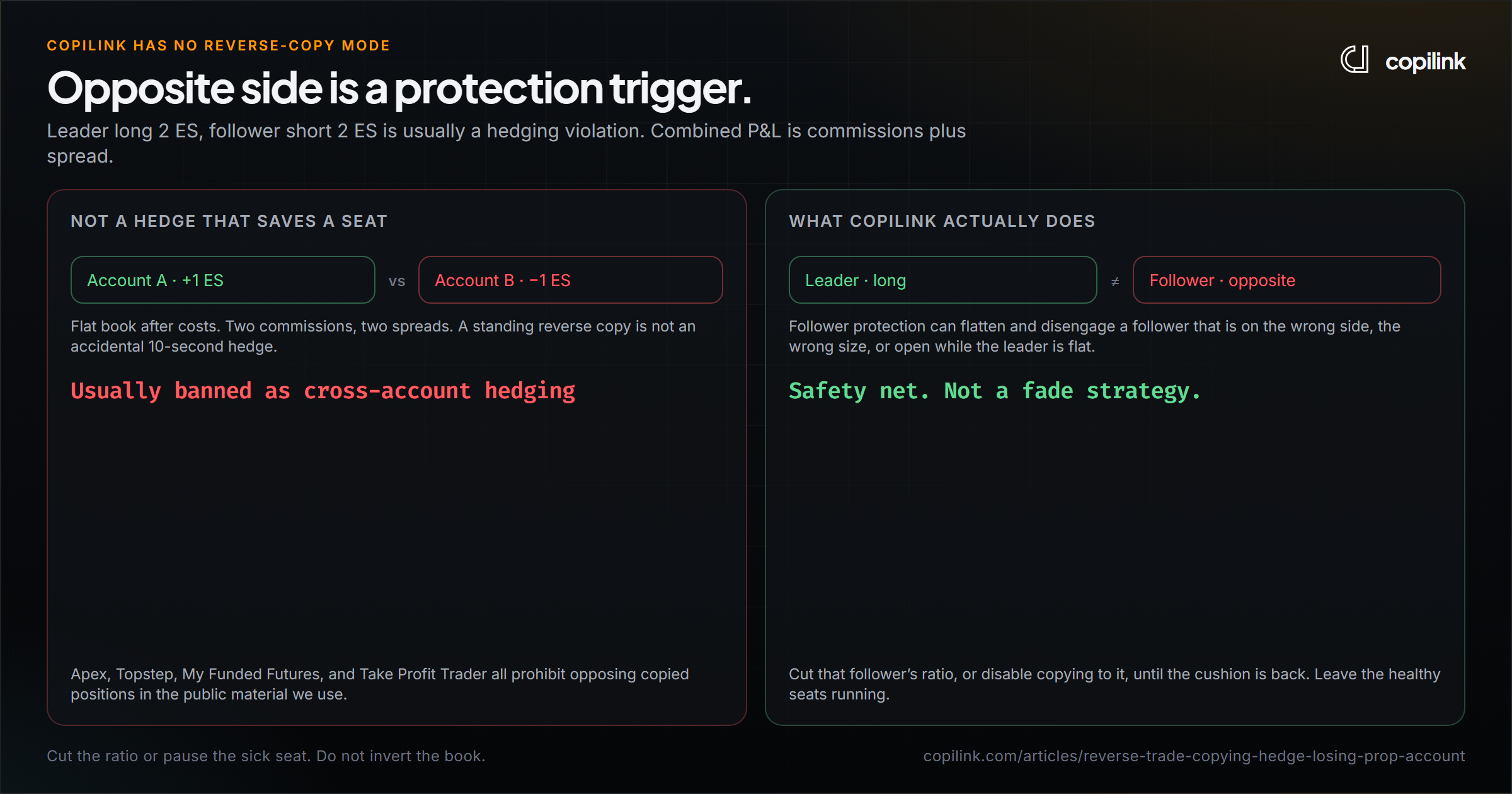
- Opposite positions across accounts in the same or correlated products.
- Tools the firm has not approved, where it restricts third-party software.
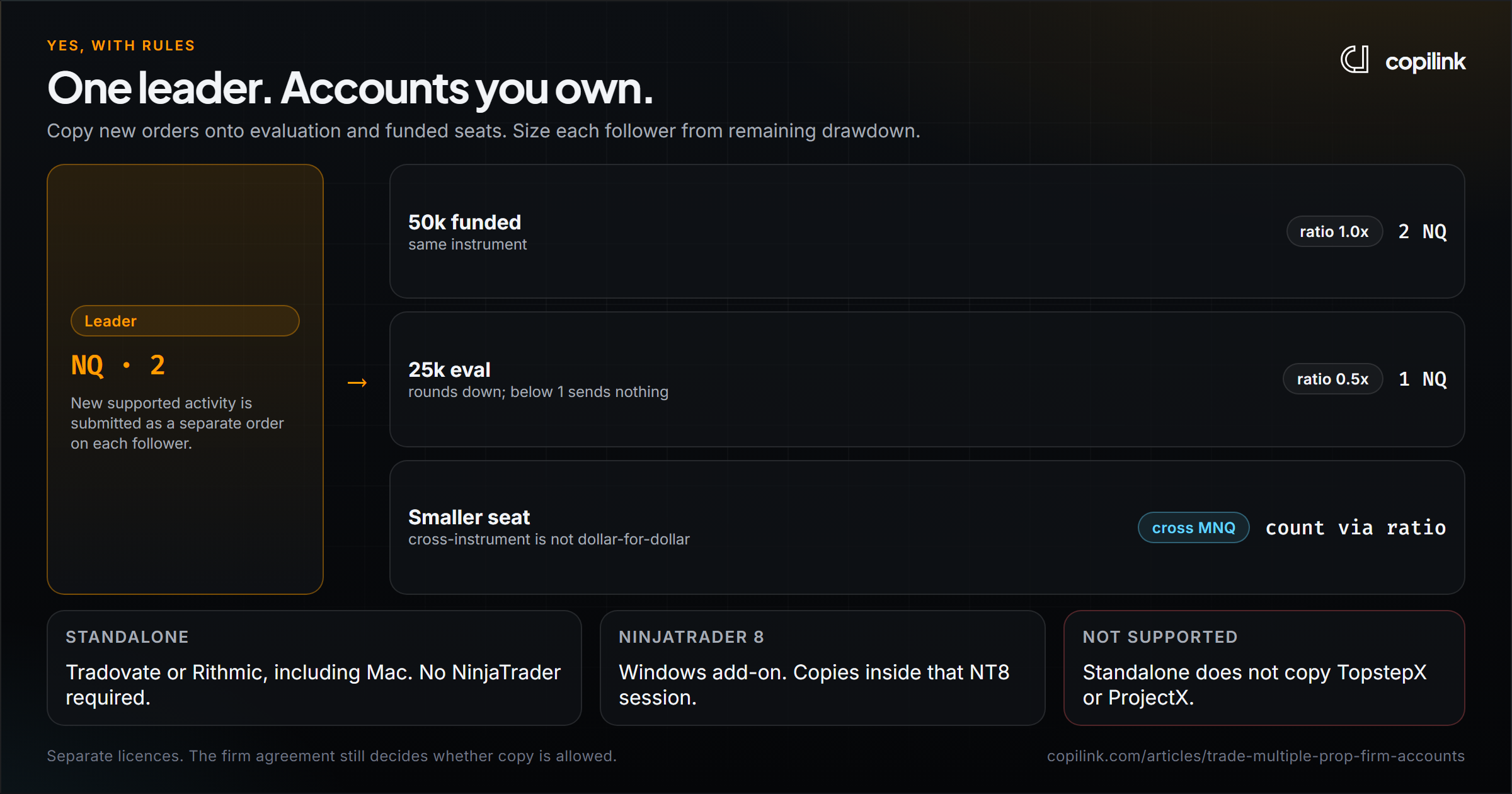
Rules differ a lot. Take Profit Trader, Bulenox and Elite Trader Funding restrict which copiers you can use. Earn2Trade bans copiers in every program. The prop firm rules directory shows each firm's current copying rule.
When a firm's terms say "no automated trading" and you are unsure whether that covers a copier, ask them in writing: "Can I use a trade copier to repeat my own manual trades across accounts I own?" Keep the answer.
How a copier creates accidental violations
Most flags on legitimate setups come from a copier doing something the trader did not intend:
- A stale position on one follower. The leader goes long while one follower still holds yesterday's short. That is a hedge, even by accident. Start every session flat and use follower protection.
- A manual trade on a follower. Trading a follower by hand while copying is on can put it opposite the leader.
- Copying through a news blackout. One leader order becomes five restricted trades.
- Mixing stages a firm keeps separate. TradeDay, for example, does not allow positions across Funded Live and its sim accounts at the same time.
How to set up copying so it does not get flagged
- Confirm each firm allows copying between your own accounts, and with your specific tool.
- Keep every account in your own name.
- Start every session flat on every account.
- Turn on follower protection so an opposite or leftover position is flattened.
- Pause copying during news windows your firms restrict.
- Do not trade followers by hand while copying is on.
What happens if your account is flagged
Most reviews start and end quietly: an analyst looks at your trades and clears them. If a firm contacts you:
- Answer quickly and plainly. Explain that you trade one leader account yourself and a copier repeats those trades on other accounts you own.
- Offer your trade records. They show the leader trading first and followers following.
- Do not argue or hide anything. A clear explanation resolves most cases.
If the firm confirms its rules do not allow your setup, trade that firm without a copier or move those accounts to a firm that allows it. Accounts are closed for real violations like hedging schemes, shared credentials or evaluation gaming.
FAQ
Can prop firms detect copy trading?
Yes. They see every order on every account. Copying between your own accounts is allowed at most futures firms that permit copiers; the firm cares about how you copy, not whether.
Will using a trade copier get my funded account closed?
Not at a firm that allows copiers, if you copy only your own accounts in the same direction. Closures come from hedging, account sharing and banned tools.
Can I copy trades between accounts at different prop firms?
Usually, if both firms allow it. Some add conditions, like matching identity or requiring trades to start on their platform. See trading multiple prop firm accounts.
Do prop firms allow automated trading?
It varies. Many allow a copier that repeats your own manual trades but ban fully automated bots or third-party algorithms. Check each firm's current rule.
Continue this topic
Compare prop firm rules and account routes →Trade without NinjaTrader
Copilink Standalone is a futures trade copier for Tradovate and Rithmic on Windows and macOS. The trial lasts 14 days and does not require a card.
Already use NinjaTrader 8?
The Copilink NinjaTrader 8 trade copier runs inside NinjaTrader 8 on Windows and includes a separate 7-day trial.