Reverse copy trading on a prop account: why it usually fails
Reverse copying puts a follower on the opposite side of the leader. On futures prop accounts that is usually a hedging violation, and combined P&L is costs.
From Copilink, which makes trade copiers for running several futures prop firm accounts from one leader. See how it works →
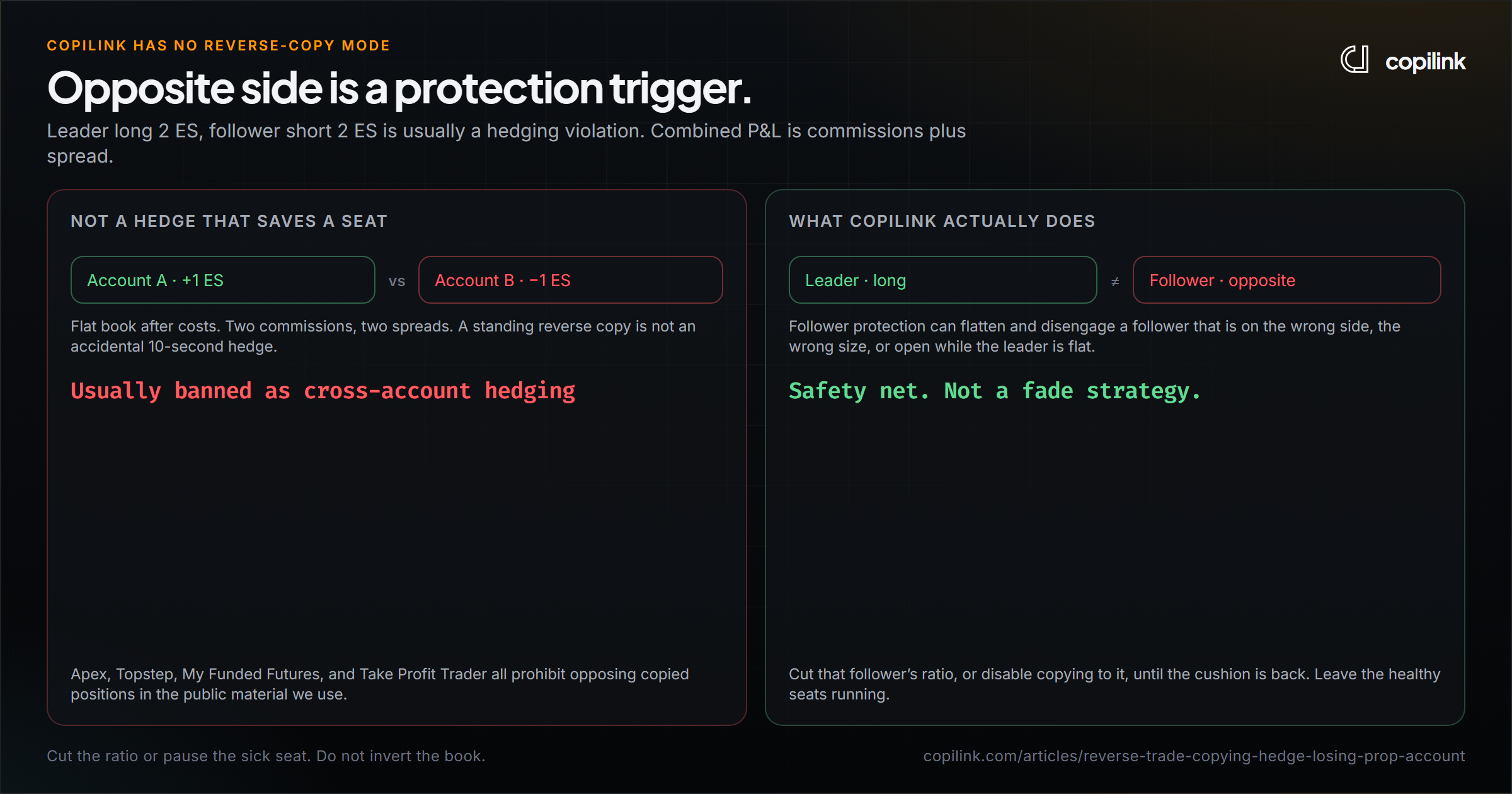
Reverse copy trading means a follower submits the opposite side of the leader: leader long 2 ES, follower short 2 ES. On futures prop accounts that is usually a hedging violation, and the combined P&L of the two seats is commissions and spread. It is not a hedge that saves a losing funded account.
If a firm has questioned your copier setup, the firm warning guide separates copying permission from the account behavior that can breach a rule.
Copilink does not offer a reverse-copy mode. Opposite direction on a follower is treated as a mismatch. Follower protection can flatten and disengage a follower that is on the wrong side of the leader. That is a safety net, not a strategy.
What reverse copy actually does
Some copiers expose a per-follower "reverse" or "fade" flag. The software inverts the side before it sends the follower order. Technically simple. The firm rule is the problem.
If both accounts stay open, you are long and short the same instrument at the same time. Tradeify has described a short tolerance window (on the order of 10 seconds) for accidental hedges. A standing reverse copy is not an accident. Apex, Topstep, and My Funded Futures also prohibit cross-account hedging in the public material we use. Take Profit Trader separately bans opposing copied positions. Recheck the current rulebook; none of those firms have advertised reverse copy as a feature.
The P&L is not a hedge
Account A +1 ES and Account B -1 ES is a flat book after costs. You pay two commissions and you eat two spreads. Over a session that is a slow leak, not protection.
The story people tell is that different drawdown models make the pair useful: put the tight intraday trail long into a trend, put the looser account short as insurance. You can get asymmetric size without taking opposite sides. Cut the struggling account's ratio. Pause copying to it. You do not need a short to do that.
What to do with a funded account that is in a hole
- Lower that follower's ratio so the same leader trade spends less of its remaining floor.
- Disable copying to it until the cushion is back.
- Leave the healthy accounts running. One sick seat is not a reason to invert the book.
Size from remaining drawdown after a cushion. The futures position size calculator is the arithmetic. The trail mechanic is intraday vs EOD trailing drawdown.
Same-direction copying is the product
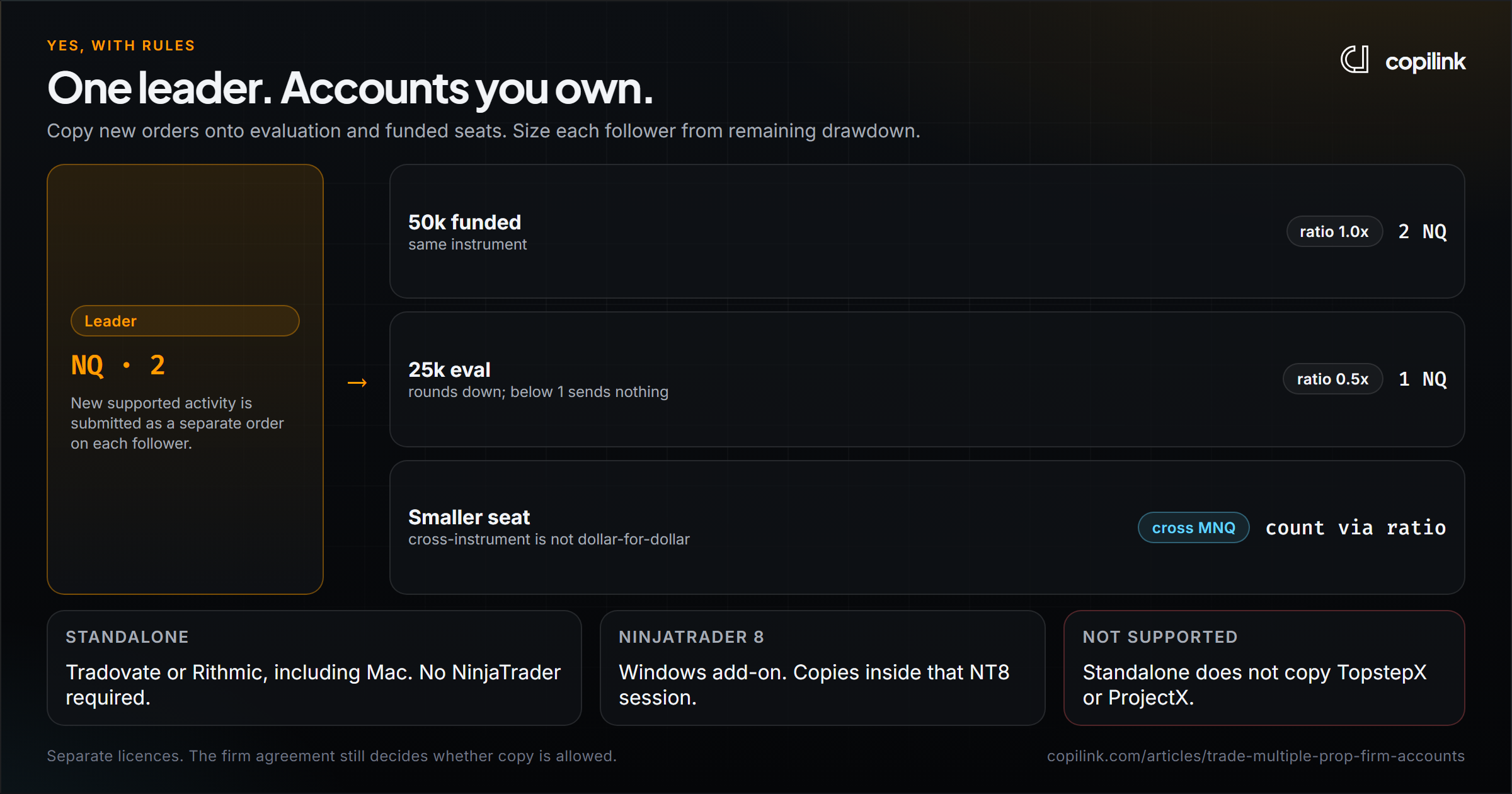
The allowed setup at most futures firms is: accounts you own, same side, sized per seat, with a copier that can stop a follower that drifts. That is how to trade multiple prop firm accounts, and the firm list is prop firms that allow copy trading.
If the accounts are on Tradovate or Rithmic, Copilink Standalone copies the leader in the same direction and can flatten a follower that is the wrong size, open while the leader is flat, or on the opposite side. Compare Copilink with Tradecopia, TradeSyncer, Replikanto, and FutuCopy on the best trade copier for prop firms page.
Do not reverse-copy a prop seat to "save" it. Reduce size or sit it out.
Continue this topic
Compare prop firm rules and account routes →Trade without NinjaTrader
Copilink Standalone is a futures trade copier for Tradovate and Rithmic on Windows and macOS. The trial lasts 14 days and does not require a card.
Already use NinjaTrader 8?
The Copilink NinjaTrader 8 trade copier runs inside NinjaTrader 8 on Windows and includes a separate 7-day trial.