Intraday vs EOD trailing drawdown: how the floor moves
Intraday trailing drawdown follows open equity in real time; EOD only moves at the close. 50K examples, the cushion math, and which one is easier to pass.
From Copilink, which makes trade copiers for running several futures prop firm accounts from one leader. See how it works →
Calculator
Enter your allowance and peak to see where your EOD or intraday floor sits and how much room is left.
Illustrative inputs · replace with your account values
When the highest balance or equity can move the floor.
The firm's maximum loss amount for this account.
Use the firm's checkpoint, not the account's nominal label.
Include unrealized P&L if the firm's breach test does.
Leave blank if this program does not lock its floor.
Calculated threshold
This is arithmetic from your inputs, not a firm or broker balance. It excludes commissions, slippage, resets and program-specific breach rules.
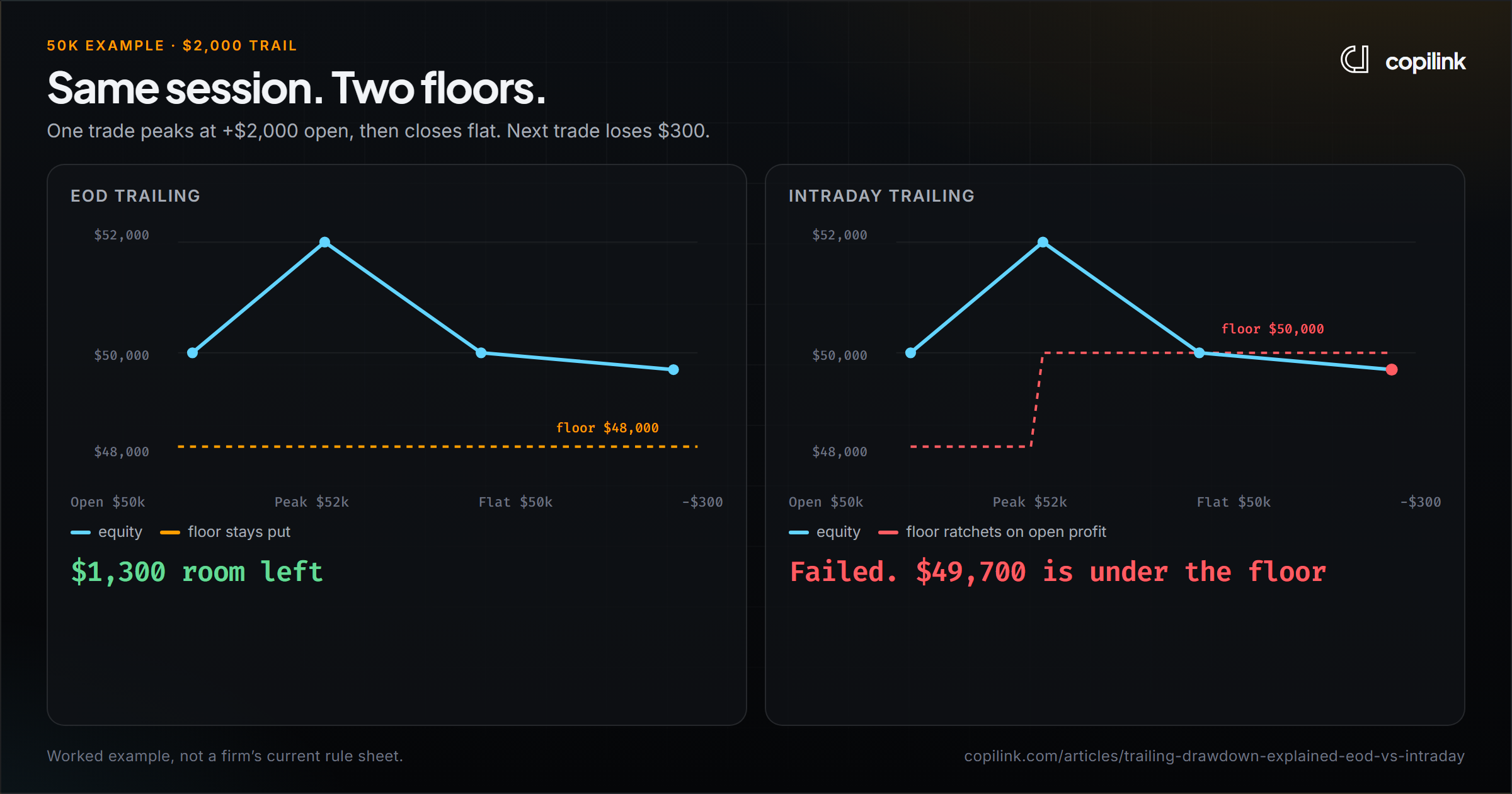
An intraday trailing drawdown follows your highest account equity in real time, including open profit. An end-of-day (EOD) trailing drawdown only moves after the session close, based on your closing balance. Both floors end the account if equity touches them during trading. The difference is when a new high pulls the floor up.
| Intraday trail | EOD trail | |
|---|---|---|
| What sets the high | Peak equity, including open profit | Highest closing balance |
| When the floor moves | On every new equity high | Once, after the daily close |
| Open profit you give back | Still raises the floor | Does not raise the floor |
| Can you fail mid-session? | Yes | Yes, if equity touches the current floor |
| More forgiving for | Quick exits that rarely give back profit | Trades that swing into profit and pull back |
Want your own numbers? Enter the peak, allowance and lock point in the trailing drawdown calculator.
What is a trailing drawdown?
A drawdown floor is the lowest account value a firm allows. A static floor stays at one level. A trailing floor rises when the account makes a new high and never moves back down.
On a $50,000 account with a $2,000 trail, the starting floor is $48,000. If the relevant high reaches $51,200, the floor rises to $49,200. What counts as "the high" is the whole difference between the two models.
The same trade under both models
A $50,000 account starts with a $48,000 floor. One trade reaches $1,200 of open profit, then closes for a $200 gain. No earlier high, no lock.
| Event | Intraday trail | EOD trail |
|---|---|---|
| Start: $50,000 balance | $48,000 floor | $48,000 floor |
| Open trade peaks at $51,200 equity | Floor rises to $49,200 immediately | Floor stays at $48,000 |
| Trade closes at $50,200 | Floor stays $49,200 | Floor stays $48,000 until the close |
| Floor for the next session | $49,200 | $48,200 |
The closed gain is $200 either way. But the intraday account now has $1,000 of room and the EOD account has $2,000. The missing $1,000 is open profit that was given back, not a realized loss.
Intraday drawdown math: how a winning trade shrinks your room
This is where most intraday breaches come from. Same $50,000 account, $48,000 floor, flat to start.
- You buy. The trade runs to $1,200 of open profit. Equity is $51,200, so the floor jumps to $49,200.
- The trade reverses. At $800 below your entry, equity is $49,200. That is the floor. The account fails.
You started with $2,000 of room, but the trade only had $800 of room from entry, because the move in your favor pulled the floor up first.
Two numbers keep you out of trouble:
- Cushion = current equity (including open P&L) - current floor. It changes every tick.
- The largest pullback you can take from the peak equals your cushion at the peak. Not your cushion at entry.
What is EOD trailing drawdown?
With an EOD trail, the firm takes your highest closing balance after the session, subtracts the allowance, and fixes that floor for the next session. Intraday swings in open profit do not move it.
Example: a $50,000 account with a $2,000 EOD trail closes at $50,600. The next session's floor is $48,600. During that session, equity can swing up and down without moving the floor, but touching $48,600 still fails the account. "EOD" describes when the floor moves, not a grace period after you cross it.
Which is better: EOD or intraday trailing drawdown?
For most traders, EOD is more forgiving. Open profit you give back during the day does not tighten the floor, so a trade can run and pull back without costing you room. Intraday rewards traders who take profit quickly and punishes letting winners breathe.
Firms often balance that out elsewhere. EOD plans may cost more or add a daily loss limit. Apex, for example, pairs its 50K EOD evaluation with a $1,000 daily loss limit, while its intraday evaluation has none. Compare the whole rule set, not just the trail type.
Apex intraday trail vs EOD trail
Rules checked 26 September 2026. Apex Trader Funding sells both intraday and EOD evaluations. The 50K versions each have a $2,000 maximum drawdown and a $3,000 profit target. The EOD evaluation adds a $1,000 daily loss limit; the intraday evaluation has none.
- Intraday: the threshold follows peak balance in real time, including open profit.
- EOD: the threshold recalculates from the highest closing balance at 4:59:59 p.m. ET and holds through the next session.
- Both: touching the threshold triggers liquidation.
Does the Apex trail stop moving? On a Performance Account (PA), the threshold stops rising at starting balance plus $100, so a 50K PA locks at $50,100. On evaluations it depends on the route: Rithmic and WealthCharts thresholds can lock at the profit-target balance, while Tradovate evaluation thresholds keep trailing.
Do no-activation-fee evaluations use different drawdown rules? No. They use the same drawdown structure as the matching standard evaluation. The fee option only changes what you pay at PA activation.
See all current Apex payout, consistency and account rules on the Apex Trader Funding rules page.
Running several accounts with different floors
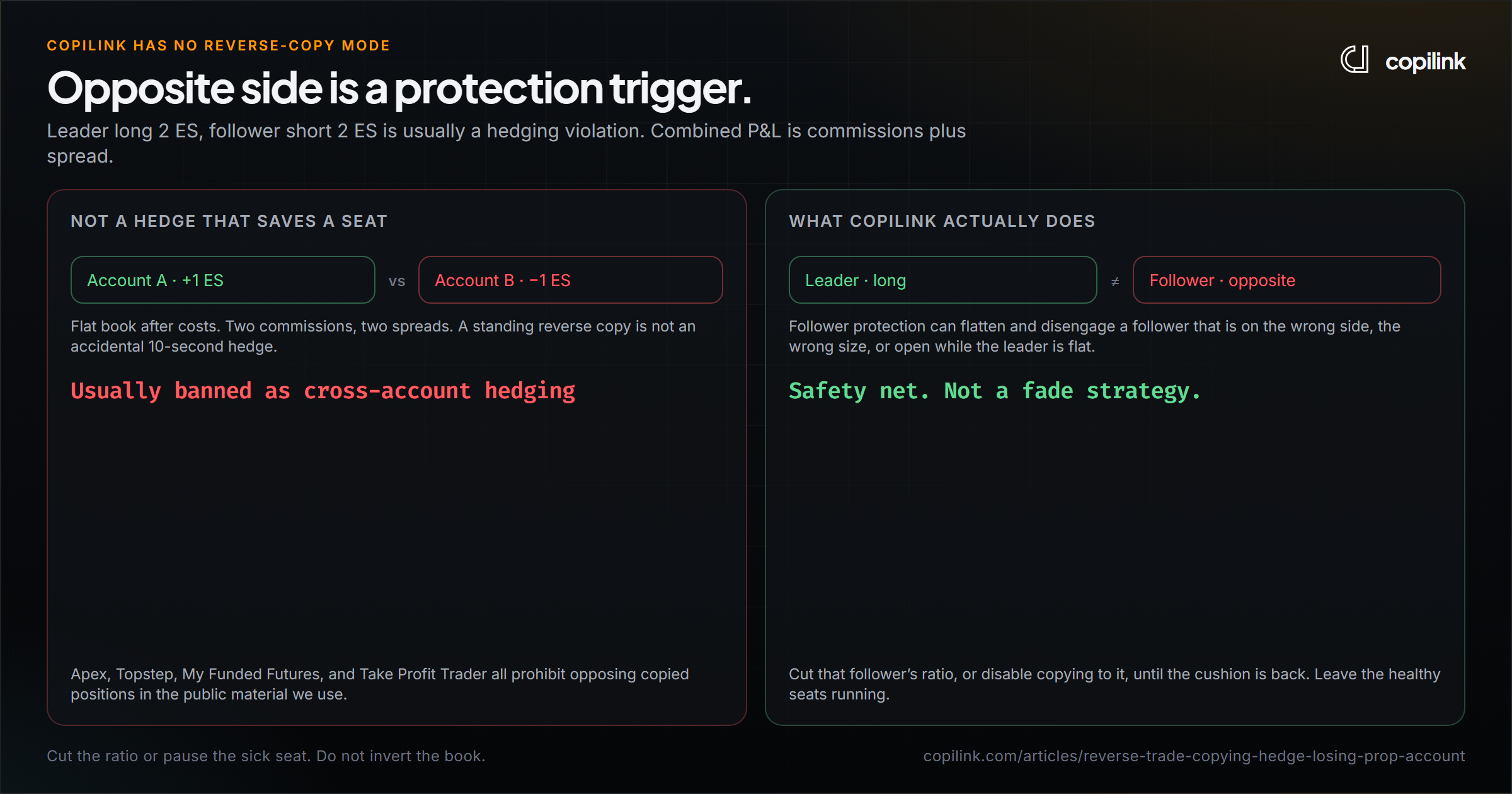
A copier sends the same decision to every account, but each account keeps its own balance, floor and route. A follower can have much less room than the leader while holding the same number of contracts.
- Size each follower to its remaining cushion, not the account label. The futures position size calculator does this per account.
- Copying a mini to a micro changes dollar risk per tick, not the firm's rule. See NQ to MNQ copy sizing.
- Put daily loss limits on every follower. The multi-account risk guide covers the full setup.
Copilink Standalone copies between Tradovate and Rithmic accounts and can act on per-account daily loss, daily profit and evaluation limits. It shows trailing drawdown for monitoring but does not enforce a firm's moving floor, so your firm dashboard stays the record. See how it works on the Apex trade copier page, or compare firms in the prop firm rules directory.
FAQ
What does "intraday trail" mean?
The drawdown floor trails your highest equity during the session, including unrealized profit. Every new equity high raises the floor immediately.
Does unrealized profit count toward a trailing drawdown?
On an intraday trail, yes. On an EOD trail, no. Only the closing balance moves the floor.
Can you fail an EOD account during the day?
Yes. The EOD floor only moves at the close, but if your equity touches the current floor at any point in the session, the account fails.
Is EOD or intraday better for passing an evaluation?
EOD usually gives more room if your trades swing into profit before you exit. If you scalp and rarely give back open profit, the two behave similarly, so compare price and daily loss limits too.
When does a trailing drawdown stop moving?
Many firms lock the floor once it reaches a set level, often the starting balance plus a small buffer. Check your firm's rule for the exact lock point and whether it differs by account stage or route.
Continue this topic
Calculate an end-of-day or intraday drawdown floor →Trade without NinjaTrader
Copilink Standalone is a futures trade copier for Tradovate and Rithmic on Windows and macOS. The trial lasts 14 days and does not require a card.
Already use NinjaTrader 8?
The Copilink NinjaTrader 8 trade copier runs inside NinjaTrader 8 on Windows and includes a separate 7-day trial.